
Skinxiety
Social Platforms Are Ruining Your Skin
THATKGLOW · BY THATKHOE
This post was written a long time ago, by someone (me) frustrated in the current state of the skincare industry. I have since published this post and created this free resource, which give a lot more actionable advice and explain how to build a proper skincare routine.
The reason TKG exists is because I want the next generation of skincare enthusiasts experience slow, mindful skincare, slow content, and better results that it brings over years and decades.
There’s a lot of reasons for why I run a long-form, text-first blog (instead of pushing products down your throat on TikTok), the main one being I’ve been stuck for years listening to the wrong advice and chasing the wrong ends that cost me – and many others – so much time and skin health that we will never get back. If you can enjoy a slow approach to skincare you will be able to see through the aggressive marketing fads happening in today’s online climate, be a more mindful consumer, and have the space to truly understand your skin and lifestyle context.
For my best resources check My Skin Library and My Skin Consult.
Picture this: You open TikTok for a toner rec.
Thirty minutes later you have a loaded cart on 4 different platforms, you’re greedy for results and have that “itch” to spend, and your skin feels like it’s not enough.
Even though nothing actually touched your face.
That’s Skinxiety: a loop of comparison, impulse buys, and infinite bad advice that feels like “skincare research.”
You think you’re just watching skincare content – but what you’re really consuming is anxiety, comparison, and unrealistic beauty standards – on a never ending loop.
You’re essentially trading your sanity and time just to end up feeling like sh*t from seeing so many people with perfect, glowy skin on your feed.
What started as curiosity usually turns into a self-esteem crisis. And that’s become such a frequent thing that you might not even be aware of it anymore.
Not because your skin changed. But because your perception of it did.
That is not skincare.
Skincare is supposed to be taking care of your skin – and you’re going in the complete opposite direction.
That’s what skinxiety is for me.
A slow erosion of trust in your own skin, fueled by filters, comparison, and an (online) environment that can’t be shut down or stopped.
It isn’t one crisis.
It’s a constant pressure that makes you tweak, overthink, and stop listening to your own skin.
And the worst part is it doesn’t feel like manipulation.
It feels like research. Like you’re staying “in the know.” Like you’re just window shopping or checking out the newest trends.
If you didn’t find yourself in these lines, you likely won’t get much value from the rest of this post.
If you did, this is one of the most important posts you will read on skincare ever.
Not because you’ll find the hidden secret to great skin for life here.
But because I can (hopefully) convince you that what’s discussed in this post will completely change your perspective on the topic of skincare and good skin.
Because behind the scenes screens, your skin is paying the price.
Skinxiety = a slow erosion of trust in your own skin. Fueled by filters, comparison, and a feed that never sleeps. It disguises itself as “research” but shows up as a thousand tiny thoughts:
This post isn’t here to tell you to delete your apps or throw your phone into the ocean.
It’s here to show you how the online environment and “advice” is slowly training and rewiring your brain. And your skin is on the receiving end of it all.
The good news is that, once you see it, you can actually start taking some power back.
What Is Skinxiety – And Why It’s Not Just In Your Head
Skinxiety isn’t some made-up buzzword.
Made-up – yes. (I love cringe terms like that. They stick 😀)
Buzzword – no.
It’s real and it’s everywhere. And the worst part is most of us don’t notice it happening.
One of my missions with this blog is to make skinxiety the a proper buzzword.
Because being aware of it is free, and if consumers in the 2020s became aware of what’s happening in the skincare circles, I believe just this awareness would have an infinitely better ROI on skin than expensive products and fad treatments.
That’s my mission.
Throwing that word around is not making me any money.
And I hope you don’t take my words in this post as fear-mongering. You should be the judge how much this applies – or doesn’t apply – to you.
As with all things skincare – YMMV.
It’s the low-level anxiety loop you fall into after consuming too much (in this case, skin care) content, usually disguised as “learning.”
For the purpose of this post and my blog’s readers, I’m referring to skincare-specific content throughout this post.
But this type of toxic content is likely the MVP and best-converting type of content in any comparison-driven niche. Which are most all niches online nowadays.
The overall message can be applied to most every sphere of your online life.
It starts off subtle, then seeps into your self-image, your confidence, your spending habits, and eventually your skin health itself.
It’s like a little internal voice that you can’t get rid of.
First it tells you your skin looked fine this morning.
But now that you’ve seen five girls with glass skin and tight cheekbones, you suddenly “look” tired, textured, and dry.
It’s what makes you feel guilty for skipping a step. Or nervous when trying a product. Or irritated that your skin didn’t respond fast enough to the new product you blew $50 on.
It’s what makes you believe that unless you constantly have that glow, poreless, 24/7 calm, you’re doing something wrong.
The worst part is, none of it feels like anxiety.
- It feels like you’re just staying informed.
- It feels like you’re being a “responsible” consumer.
- It feels like you’re trying harder to do it right.
And that’s exactly how it sneaks in.
Skinxiety isn’t about one “dramatic” moment of feeling like this.
It’s about the accumulation of 1,000 tiny, self-eroding thoughts caused by nonstop comparison and overload.
Over time, that builds internal pressure.
You start overthinking every product. Or tweaking your routine every week.
We’ve outsourced so much of our decision-making to influencers and filters that we’ve forgotten how to read and listen to our own face.
And eventually you stop trusting your skin completely.
The Scroll Is Designed to Make You Feel Inadequate
The beauty industry isn’t broken (well, it is, but that’s a topic I discuss on way too many posts) – it’s engineered to keep you stuck in a loop of comparison, confusion, and chasing.
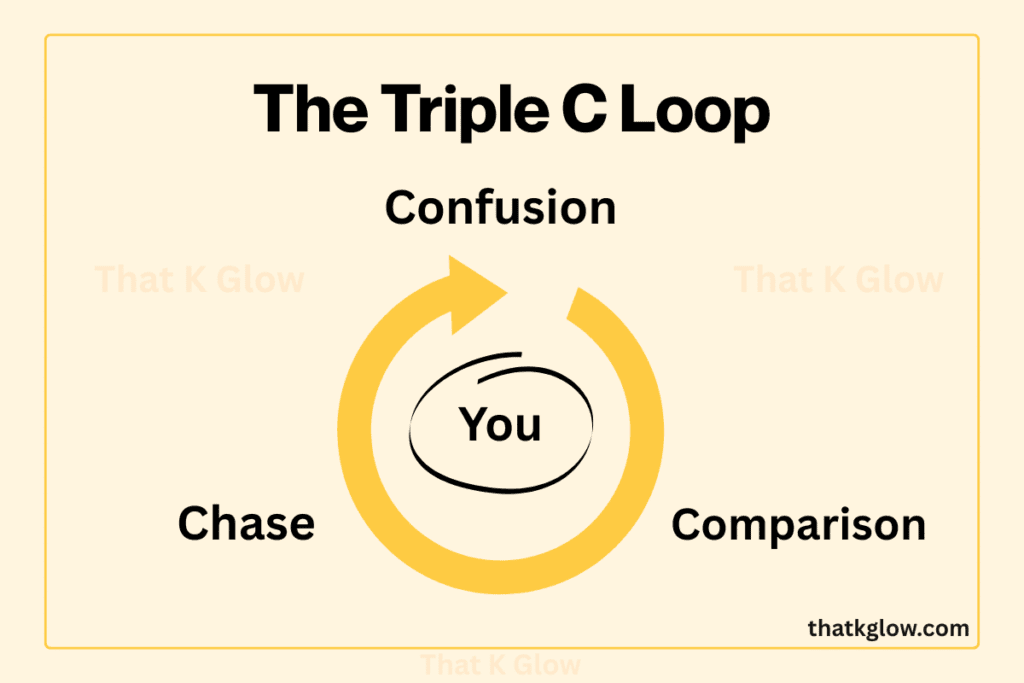
It’s operating exactly as per design.
And now that beauty and skin content lives on TikTok, YouTube, and Instagram 24/7, your access to that loop is unlimited.
What you’re seeing isn’t “advice.” It’s performance.
People with genetic lottery skin, 8 filters, ring lights, post-facial glow, and strategic blurring – giving you 10-step routines that pretend to be a surefire ticket to “perfect” skin.
Our brains believe what they see. Even if it’s just pixels on our screens.
And our 2-million-year-old brain can’t out-logic an app built to hack dopamine.
We haven’t evolved enough for our minds to be able to tell the difference between what’s real and what’s on our phone. The human brain is 2million years old. Modern phones are – what? 15?
And that’s not even counting those old flip phones, because they didn’t have social media on them.
And our mind doesn’t care that what we see is a filter. Or that the lighting is from a $300 setup. Or that that person-from-the-other-screen’s job is literally to look perfect, and to find ways to enhance that.
All our brains register is this: “They look better than me. What am I missing?”
This is where Skinxiety sets its roots.
Because the feed doesn’t just feed you skincare ideas – it feeds you standards.
(no pun intended)
Unrealistic, unachievable, and definitely unsustainable standards.
Even dermatologists are turning into influencers now. Because it’s what’s most profitable.
You’re not just being sold a product – you’re being sold a lifestyle.
And a promise that if you follow everything “right,” you too can never have to deal with “bad skin days”.
How Skinxiety Keeps You in the Product Loop
Skinxiety doesn’t just make you feel bad.
It makes you buy.
It’s the reason many of us keep panic-adding products to our carts.
It’s what pushes us to “reset” our routines every time we see a new trending serum.
And I bet there are plenty of you whose bathroom shelf is a graveyard of half-used bottles.
And skinxiety convinces you that the solution is always external.
But from a routine and product perspective, what you’re really doing is this:
- Layering too many actives without understanding how they interact
- Switching routines so often your skin never gets a chance to stabilize
- Blaming your genes when your skin doesn’t react fast enough to a formula it never needed in the first place.
This loop isn’t accidental – it’s profitable.
VERY EFFING PROFITABLE.
The more desperate you feel, the more impulsively you buy.
The more confused you are, the more content you consume.
The more content you consume, the more broken you feel.
And the cycle continues.
You’re not addicted to skincare. You’re addicted to the illusion that something’s missing.
That if you just find that one right thing, you’ll finally feel good in your skin again.
But the loop was never designed to end.
The Psychological Cost (And Why It’s So Hard to Stop)
This is the last section before I give you the answer that got me out of skinxiety. It’s very short, but if you got the point by now feel free to go to the solution section just below.
Let’s be clear: this isn’t a “just unfollow and you’ll be fine” kind of problem.
This runs deeper than that.
When your brain is constantly flooded with new information, new routines, new faces, new flaws to notice—you lose the ability to hear your own skin.
You stop making decisions based on reality.
And start making them based on emotion.
Every time you scroll, your nervous system gets hit:
- A new influencer’s perfect skin = comparison
- A new “life-changing” product = urgency
- A new myth to bust = more doubt
And when we’re operating from a place of overstimulation, overload, uncertainty – we don’t slow down.
We speed up.
We tweak, overthink, stack, fix, search.
It’s in our human nature. And it’s something brands have known for a long time.
So of course it’s hard to stop.
It’s not just about quitting a habit – it’s about getting away from a system that’s designed to keep us chasing.
The second you step back, even a little, you’ll start to feel a little bit of clarity and relief.
A weird sense of “oh sh*t… maybe I don’t need anything new right now.”
The first look that your skin doesn’t need more products.
Good skin doesn’t come from perfect routines.
It comes from knowing when to stop messing with it.
If being influenced by Skinxiety has taught me anything, it’s that more information doesn’t always equal better decisions.
And more products definitely don’t equal better results.
Let’s simplify.
1. Unfollow Everyone that makes you feel “less”
As I said, the solution to skinxiety isn’t a “just unfollow and you’ll be fine” kind of problem. But it starts at that.
If someone’s content makes you anxious, overwhelmed, or hyper-aware of your “flaws,” that’s your cue to mute, unfollow, or step away.
Even if they’ve got the little blue tick.
If you’re anything like most people interested in the topic of skincare, then your skincare feed should feel like a tool that lets you have better skin. Not an anxiety-inducing loop.
2. Audit Your Routine
Ask yourself:
- Do I even know what each product in my routine is doing?
- Did I buy this because of hype, or because my skin actually needed it?
- Is my routine built on FOMO and hype or results?
Yes it’s going to take time out of your day.
Yes you might feel stupid while doing it because you can always buy new products.
But that’s the point.
I’m not a derm – but I also don’t make fat commissions from affiliated brands for telling you to use their products – while charging you $300 for a 30-minute “consultation”.
The point is – cut the hype stuff. Keep only what’s essential.
3. Give Your Skin a Scroll-Free Window
This is a cliche, and it may not work for everyone. But it’s totally worked for me.
Especially on bad skin days.
Ironically, what we end up doing the exact opposite.
Have bad skin → must scroll on TikTok
You don’t need to expose your brain to 40 faces with good skin when you’ve got a bad skin day.
Instead, just take a day off social media.
Go outside. Touch grass. Do something that has nothing to do with your skin, your appearance, or how to ‘optimize’ your life. Reconnect with your skin in real life.
4. The Relationship With Your Skin
Skin trust isn’t built overnight. Especially in a generation like ours.
Like any long-term relationship – it requires patience, consistency, and actually listening.
I mean, you only have one skin from the moment you’re born. Might as well treat it well and build an amazing relationship with it.
Main point – stop treating your skin like a project that constantly needs upgrades.
In most cases it will actually feel better. And you’ll start to feel more confident in it.
In Short:
- Pick a routine, stick with it, and stop tweaking every week
- Normalize skin fluctuation. No one is has perfect, glowing skin 24/7
- Consider your skincare routine as a support system, not a makeover
That’s it for this post.
Thanks for reading.
K. Hoe